
We hold these truths
The NatCons' unalienable rights are rooted in universal truths

Emir Kir, Mayor of Saint-Josse, Brussels provided a useful reminder this week that the right to peaceably assemble and to speak one’s political or religious views is a non-negotiable for free societies. He attempted to shut down the National Conservatives’ 2024 convention at the Claridge hotel “to ensure public security.”
Mayor Kir’s actions were condemned including by groups critical of National Conservatism. (I added my name to one such letter). Belgian prime minister Alexander de Croo blasted the abuse of municipal authority to override the Belgian constitution’s guarantee to freedom of speech and assembly.
Why this conference?
The speakers represent a variety of views on the European and American right including opposition to immigration, a bold defense of Judeo-Christian principles in culture and law, EU-skepticism, anti-globalization, nationalist-centric sovereignty, and a preference for social democratic frameworks for market economies. As with any group of more than two people not all attendees consider themselves NatCons and not all NatCons are mutually aligned.
There is much to unpack about what makes NatCons different from other kinds of American conservatives most notably the “FreeCons” who represent the “Buckley-Reaganite” fusionism that came to define the Republican Party for a few generations.
NatCons sound conservative on some policy issues but their political principles and governing vision are “unmoored from the American tradition.” That drift has lead them to seek inspiration from Continental and reactionary sources, leading to philosophical dissonance and practical contradictions.
Scott Lincicome hones in on a foundational and unbridgeable gap between the NatCons and FreeCon/fusionists.
For the NatCons “the state” acts on behalf of the people within its borders by pursuing the national interest and upholding national traditions. This is, ironically, a major departure from “the American tradition” in which “the people” have rights and “primacy….over their government”
The NatCon Statement of Principles seeks a limited administrative state, but then makes a troubling exception justifying the use of state authority in certain circumstances.
“…where law and justice have been manifestly corrupted, or in which lawlessness, immorality, and dissolution reign, national government must intervene energetically to restore order.” (Principle 3)
We are left to imagine who gets to define what constitutes a breakdown in order and how it might be restored. On this point alone the NatCons invert the relationship between the government and the people as stated in The Declaration of Independence.
“We hold these truths to be self-evident, that all men are created equal, that they are endowed by their Creator with certain unalienable Rights, that among these are Life, Liberty, and the pursuit of Happiness. That to secure these rights, Governments instituted among Men, deriving their just powers from the consent of the governed.” (The Declaration of Independence, 1776)
Perhaps confusingly, the NatCons commit to the U.S. Constitution of 1787 and common law legal tradition (Principle 5). They are united in their disdain for Marxist, authoritarian, leftist ideological movements who would extinguish the basis of culture and law in the Divine.
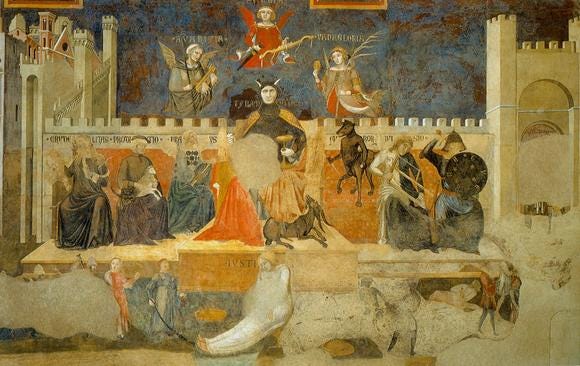
Allegory of Bad Government, Ambrogio Lorenzetti, 1338-1339
They then proceed to small “d” divinize the nation cutting off the source of human rights in the West: the recognition of authentic human freedom, conscience, and dignity, rooted in the truth and knowable by human reason.
NatCon Founder Yoram Hazony extols the (Biblical) virtues that undergird just and peaceful nations, but he rejects the existence of universal truths and with it the natural law, (both Catholic and Straussian natural rights varieties) and the natural rights tradition of the Scottish Enlightenment, in particular John Locke. He looks to Edmund Burke as a philosophical guide, but badly misreads him.
For Hazony, humans are not that reasonable and they need thick cultural or religious traditions to guide them such as the Decalogue.
In this framing, our obligations and duties extend to tribe, family, and nation - full stop. Here Hazony exits the American conservative intellectual tradition and originates his political project in Hebraic scripture and subsequently what he sees as the historical particularism of Anglo-Protestant nations. Akiva Malamet illuminates the troubling implications of “metaphysically imprisoning humans into one group…the nation.” Namely - the lack of limits on imposing one’s will on others, religious discrimination, and ethnic chauvisnism.
Hazony’s anthropology, intellectual history, and his conflation of right ‘reason’ with secular ‘rationalism,’ lead him away from the very Anglo-American tradition he praises as a model. Paradoxically, Hazony doesn’t recognize the residual natural law present in his pantheon of intellectual forbearers: John Fortescue, John Selden, and Edmund Burke.
Reason and rationalism are not one in the same. Contrary to Hazony, it can be said, consistent with the conservative tradition, that reason-aided-by-grace, or the classical virtue of prudence inform the American concept of liberty. A liberty “grounded in (and bounded by) the laws of nature and nature’s God”.
Despite these major errors it is only right that the NatCons be allowed to peaceably assemble and to speak as their consciences guide them. For those who disagree with their views, such as Mayor Kir, all the better to appeal not to force but to reason.
very thought-provoking